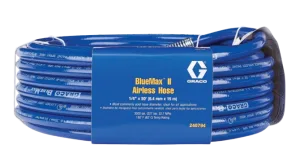
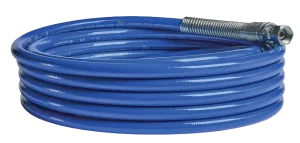
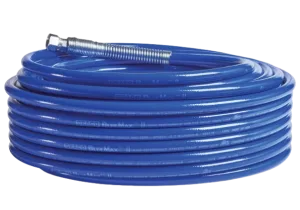
For most painting, a 1/4 inch hose rated at 3300 psi is the right choice, in 25 or 50 foot lengths. Move up to 3/8 inch for runs past about 100 feet, large tips or heavy coatings, because it loses far less pressure over distance. Add a 3/16 inch whip hose of 3 to 6 feet at the gun to cut fatigue. Whatever the size, the hose must be rated for at least your sprayer's maximum pressure, and a hose with a cut, bulge or leaking coupling is replaced, never repaired. The common BlueMax II sizes are 240793 (1/4 in x 25 ft), 240794 (1/4 in x 50 ft) and 240797 (3/8 in x 50 ft).
- Diameter and length together decide how much pressure actually arrives at the gun.
- A 3/8 inch hose has 2.25 times the cross-section of a 1/4 inch hose.
- Larger hose goes nearest the sprayer, smaller hose nearest the gun.
- Airless hose is a safety part. Damage means replacement.
- The Three Diameters and What Each Is For
- How Length and Diameter Affect Pressure at the Gun
- Pressure Rating: The Specification You Cannot Compromise On
- Choosing a Length
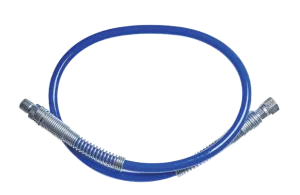
- Whip Hoses: Small Part, Large Difference
- Joining Hoses the Right Way
- Grounding and Static: Why Paint Hose Is Conductive
- When to Replace a Hose
- Making a Hose Last
- Frequently Asked Questions
The hose is the part of an airless sprayer nobody thinks about until the spray pattern starts to tail for no obvious reason. Painters replace tips, clean filters and blame the pump, when the cause is 150 feet of thin hose that was added a season ago and forgotten.
A hose does three jobs at once. It carries paint, it holds several thousand pounds per square inch safely, and it carries static electricity back to ground. Choosing one well means getting all three right, and this guide takes them in turn.
1. The Three Diameters and What Each Is For
Airless hose is described by its inside diameter. Three sizes cover nearly all painting work.
3/16 inch
Whips and fine finishThe lightest and most flexible. Used as a short whip at the gun, and as a full hose with small tips and thin materials such as stains and lacquers.
1/4 inch
The standardSupplied with most electric airless sprayers. Handles interior and exterior paints on runs up to roughly 100 feet with the tips those sprayers are rated for.
3/8 inch
Long runs and heavy coatingsFor large sprayers, big tips, thick materials and long distances. Heavier to drag, but it delivers pressure where thin hose cannot.
The reason diameter matters so much is simple geometry. Flow area grows with the square of the diameter, so a 3/8 inch hose has 2.25 times the cross-section of a 1/4 inch hose. The same amount of paint moves through it more slowly and with far less friction against the wall.
2. How Length and Diameter Affect Pressure at the Gun
The gauge on the sprayer shows pressure at the pump. The tip only sees what is left after the paint has been pushed through the hose. The difference is called pressure drop, and four things increase it:
- Length. Every additional foot adds friction. Doubling the length roughly doubles the loss.
- Small diameter. Thin hose loses pressure much faster than thick hose at the same flow.
- Flow. A large tip moves more paint per minute, and the loss rises with it.
- Viscosity. Thick or cold paint drags far more than thin, warm paint.
In practice this means a setup that sprays perfectly with 50 feet of hose can start to tail with 150 feet of the same hose and the same tip. The usual response is to turn the pressure up at the sprayer, which works until the pump reaches its limit. Past that point, the only fixes are a shorter run, a larger hose or a smaller tip.
If the pattern tails at the end of a long hose, connect the gun to a single 50 foot length and spray again with the same tip and setting. If the pattern is clean, the sprayer is healthy and the hose run is too long or too thin for that tip.
If the pattern is poor even on a short hose, the cause is elsewhere. Our guides to airless sprayer pressure settings and to a Graco sprayer that loses pressure mid-job cover those cases.
3. Pressure Rating: The Specification You Cannot Compromise On
Every airless hose has a maximum working pressure printed on it. Graco's BlueMax II hoses for painting are rated at 3300 psi, which matches the maximum pressure of most electric and gas contractor sprayers.
The rule is simple: the hose rating must be equal to or higher than the maximum working pressure of the sprayer. Not the pressure you plan to spray at. The maximum the machine can produce.
That matters most in two situations. The first is a high-pressure machine built for protective coatings, which can run well above 3300 psi and needs hose rated to match. The second is a cheap hose of unknown origin. A pressure washer hose, an air hose or an unbranded "paint hose" with no rating printed on it has no place on an airless sprayer.
A pinhole in a pressurized hose produces a jet fine enough to go through skin. Never feel along a hose with your hand to find a leak, and relieve pressure before you inspect, disconnect or move a hose that may be damaged.
4. Choosing a Length
Buy the length the work needs most days, not the longest you might ever want. Extra hose is extra weight to drag, extra paint to flush out, and extra pressure lost.
| Hose | Part number | Typical use |
|---|---|---|
| BlueMax II 1/4 in x 25 ft | 240793 | Interior rooms, small sprayers, adding reach to a 50 ft hose |
| BlueMax II 1/4 in x 50 ft | 240794 | The everyday contractor length for residential work |
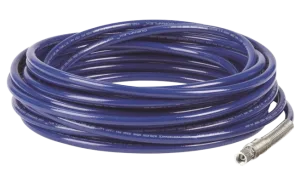
| BlueMax II 1/4 in x 100 ft | 223771 | Exteriors and long hallways with one continuous hose |
| BlueMax II 3/8 in x 50 ft | 240797 | First section of a long run, large tips, heavy coatings |
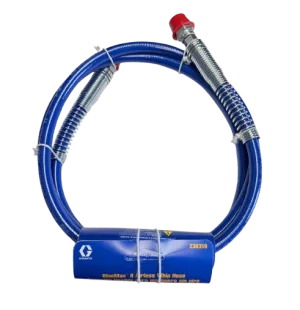
| BlueMax II 3/16 in x 3 ft whip | 238358 | Flexible lead at the gun |
| BlueMax II 3/16 in x 6 ft whip | 238359 | Longer whip for ceilings and awkward reaches |
| DuraFlex 1/4 in x 50 ft | 247340 | Replacement or longer hose for Magnum sprayers |
The full range, including longer and larger sizes, is in our Graco hoses and whip hoses section.
Every sprayer has a maximum hose length
Small sprayers cannot push paint through a long hose. Graco publishes a limit for each model: 50 feet for the Magnum Project Painter Plus, 75 feet for the Magnum X5 and 100 feet for the Magnum X7. Contractor sprayers support far longer runs, and the figure is in the manual for each one. Going past the limit does not damage anything immediately. It simply means the pattern will tail however you set the pressure. Those limits are one of the real differences between the small models, as our comparison of the Project Painter Plus and Magnum X5 explains.
5. Whip Hoses: Small Part, Large Difference
A main hose under pressure is stiff. It pulls the gun off line and makes your wrist fight it on every pass. A whip hose is a short length of 3/16 inch hose between the main hose and the gun that removes most of that pull.
Over a full day the effect is real. Less strain on the wrist means a steadier gun, and a steadier gun means a more even coat late in the afternoon when the misses usually happen. Whips are most valuable for ceilings, trim, cabinets and anywhere the gun has to change angle constantly.
Two cautions. A whip is still a restriction, so keep it short: 3 to 6 feet is the normal range. And it needs the same pressure rating as the rest of the hose. A whip rated below the sprayer's maximum is the weak point of the whole line.
6. Joining Hoses the Right Way
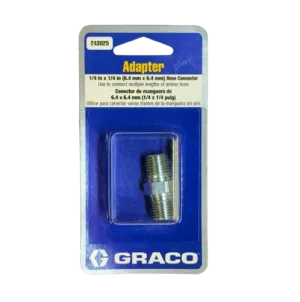
Hoses are joined with a connector that has male threads on both ends. For standard 1/4 inch hose that is connector 243025. Larger hoses and mixed sizes need the matching adapter, and those are in our gun adapters and hose fittings listings.
Three rules keep a joined run working properly:
- Largest diameter nearest the sprayer. Put the 3/8 inch hose first, then 1/4 inch, then the whip. The paint travels most of the distance in the hose that loses the least pressure.
- Tighten with two wrenches. One holds the connector, the other turns the hose nut. Twisting the hose itself strains the coupling.
- Stay inside the sprayer's hose limit. Joined lengths add up, and so does the pressure loss.
7. Grounding and Static: Why Paint Hose Is Conductive
Paint moving quickly through a hose generates static electricity. If that charge has nowhere to go, it can jump as a spark, and a spark near flammable solvent vapor is how fires start.
For that reason, airless paint hoses are built to be electrically conductive. The charge travels along the hose to the sprayer and from there to ground through the power cord or a ground wire. Graco's manuals are specific about it:
- Use only electrically conductive hoses.
- Keep the combined hose length to 500 feet or less so grounding stays continuous.
- If the resistance from the hose to ground exceeds 29 megohms, replace the hose immediately.
This is the practical reason a hose "that fits" from another trade is not acceptable. It may hold the pressure and still leave the gun ungrounded.
8. When to Replace a Hose
Inspect the hose each time you set up, by eye, with the pressure relieved. Replace it if you find any of these:
Cuts, abrasion or exposed reinforcement
Once the cover is through to the braid, the hose has lost part of its strength.
A bulge or soft spot
The inner tube has failed and paint is working into the reinforcement. This hose is close to bursting.
A kink that stays kinked
A sharp fold damages the reinforcement and restricts flow at that point permanently.
Paint weeping at a coupling
The crimp has loosened. Tightening the nut does not fix a leak between the hose and its fitting.
Flakes that keep blocking the gun filter
Cured paint on the inside wall breaks away in pieces. Flushing rarely clears it for good, and the hose will keep feeding debris to the tip.
Do not repair airless hose. Tape, clamps and re-fitted couplings do not hold airless pressure safely, and Graco's manuals say plainly not to recouple or mend high-pressure hose. Our article on when to replace sprayers, hoses and fittings goes into the wider inspection routine.
9. Making a Hose Last
- Flush it completely. A 50 foot length of 1/4 inch hose holds about 0.13 gallons, and 50 feet of 3/8 inch holds about 0.29 gallons. All of it has to be pushed out before the hose is clean.
- Coil it in large loops. Tight coils and sharp bends at the couplings are where hoses fail first.
- Keep it off sharp edges and out of traffic. Scaffold frames, door thresholds and truck tailgates do most of the cutting.
- Do not pull the sprayer by the hose. The couplings are not built for that load.
- Store it indoors. Sunlight and freezing temperatures both shorten the life of the cover.
Not Sure Which Hose Your Sprayer Takes?
Tell us the sprayer model, the tip size and how far you need to reach. We will suggest the diameter and length that will hold pressure at the gun.
Ask Our Parts Team Call +1 713-931-4102Graco Airless Hoses and Whips

 −26%
 −21%
10. Frequently Asked Questions
What size hose does a Graco airless paint sprayer use?
Most Graco airless sprayers use a 1/4 inch hose with 1/4 inch NPSM fittings, usually 25 or 50 feet long. Larger sprayers, long runs and heavy coatings use 3/8 inch hose, and a short 3/16 inch whip hose is often added at the gun for flexibility. The hose must be rated for at least the maximum working pressure of the sprayer, which is 3300 psi on many contractor models.
Is 1/4 or 3/8 airless hose better?
Neither is better in general. A 1/4 inch hose is lighter, easier to handle and right for most paints on runs up to about 100 feet. A 3/8 inch hose has more than twice the cross-section, so it loses far less pressure over distance and suits long runs, large tips and thick coatings. A common setup is 3/8 inch for most of the run, then a 1/4 inch section and a whip near the gun.
How long can an airless sprayer hose be?
It depends on the sprayer. Graco rates the Magnum Project Painter Plus for up to 50 feet, the Magnum X5 for 75 feet and the Magnum X7 for 100 feet. Contractor sprayers support much longer runs. Check the manual for your model, because every added foot costs some pressure at the gun, and thin hose costs more than thick hose.
What is a whip hose for?
A whip hose is a short, flexible length of 3/16 inch hose, usually 3 to 6 feet long, fitted between the main hose and the gun. It takes the weight and stiffness of the main hose off your wrist, which reduces fatigue and makes it easier to keep the gun square to the surface. The pressure loss over such a short length is small on a sprayer that is correctly sized for the tip.
Can I connect two airless hoses together?
Yes, with a hose connector such as the 1/4 inch by 1/4 inch fitting 243025, as long as both hoses are rated for the sprayer's pressure and the total length stays within what the sprayer supports. Put the larger diameter hose nearest the sprayer and the smaller one nearest the gun.
When should an airless hose be replaced?
Replace it as soon as you see a cut, a bulge, a kink that will not relax, exposed reinforcement, or a leak at a coupling. Do not tape it or try to refit a coupling: a high-pressure hose cannot be repaired safely. Also replace a hose that has gone stiff with cured paint inside, because the flakes it sheds will keep blocking the gun filter and tip.
Does an airless hose need to be grounded?
Yes. Paint moving through a hose builds a static charge, so airless hoses are made electrically conductive to carry it back to the sprayer and its ground. Graco's manuals call for conductive hoses only, with a combined length of no more than 500 feet, and say a hose whose resistance to ground exceeds 29 megohms should be replaced.
How much paint does an airless hose hold?
About 0.13 gallons in 50 feet of 1/4 inch hose and about 0.29 gallons in 50 feet of 3/8 inch hose. That matters when you change colors or flush, because that much material has to be pushed out before the new fluid reaches the gun.