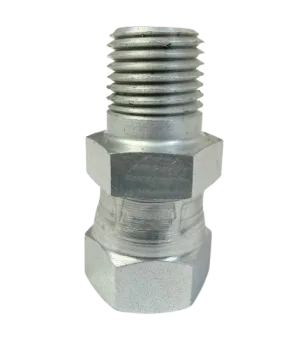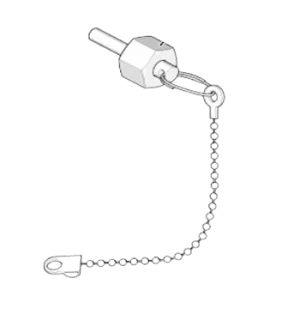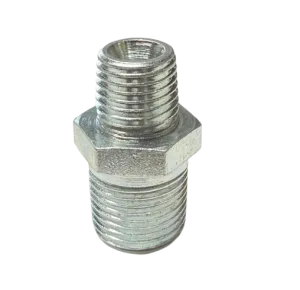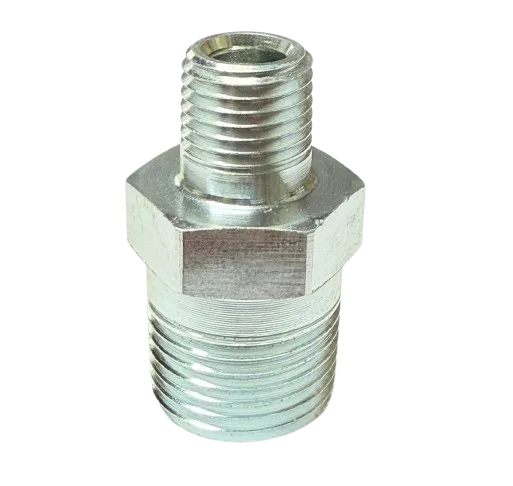
Graco 162449 Reducing Nipple Fitting
Graco 162449 Fitting Nipple Reducing: Durable Stainless Steel Connector
Optimize your fluid handling setup with the Graco 162449 Fitting Nipple Reducing, a precision-engineered connector crafted from stainless steel for maximum durability. This fitting ensures seamless integration in demanding spray applications and supports a airless sprayer environment with minimal pressure drop. Its streamlined profile reduces turbulence, maintaining consistent fluid flow and increasing overall system efficiency. Built to withstand heavy-duty use.
- Precision stainless steel construction
- Compatible with Graco pumps and hoses
- Streamlined design for minimal turbulence
Ideal for professional coatings applications, it delivers reliable performance when applying high-pressure filtration to maintain purity in advanced protective finishes. Compatibility with diverse Graco pumps and hoses makes this reducing nipple the go-to choice for contractors tackling wood, metal, concrete, and other substrates. Enhance your equipment setup for superior atomization, reduced maintenance, and extended service life in even the toughest industrial environments. Designed for long-term use, it prevents leaks and reduces maintenance downtime.
Precision Reducing Nipple Fitting 162449: Engineering Fluid Transfer with Sealed, High-Pressure Performance and Optimal Pressure Control
The Graco 162449 Reducing Nipple Fitting is engineered to optimize fluid transfer pathways within high-pressure pump systems, facilitating seamless transitions between differing port sizes in demanding industrial applications. Manufactured by Graco, this reducing fitting features precision-turned threads and a streamlined flow profile that minimizes turbulence and pressure drop across mating connections. Suitable for installation in a variety of equipment including piston pumps, proportioning systems, and manifold assemblies, it assures consistent delivery performance even under cyclic loading conditions. Its design supports integration with an air manifold loop, spray headers, and dispensing valves, making it a critical component for balancing flow rates in complex fluid circuits used in advanced airless sprayer setups.
- Material selection and compatibility per ASTM and ISO standards
- Dimensional tolerances and thread engagement specifications
- Pressure rating and safety factors for cyclic environments
Engineered to meet SAE J514 and ISO 8434-1 tolerances, the Graco 162449 fitting employs high-purity stainless steel or electroless nickel-plated carbon steel to resist corrosion in solvent-based fluids and waterborne formulations. Precision-machined sealing faces achieve optimal contact pressure to enhance professional coatings adhesion and prevent bypass leakage, while micro-finish surface treatments support extended seal longevity. This component exhibits consistent thread engagement as defined by Class 2A/2B fit, guaranteeing repeatable torque values and reliable joint integrity throughout maintenance cycles. Its compact profile allows installation in tight manifolds, auxiliary pump ports, or secondary filtration loops where space constraints demand low-profile connections without sacrificing mechanical strength.
In high-flow fluid circuits, pressure regulation often depends on fitting geometry to control flow coefficients and maintain stable output under varying back-pressures. The 162449 fitting’s internal bore is sized to minimize cavitation risk and turbulence, ensuring consistent output for high-velocity spray headers, proportioning pumps, or jetting nozzles. Its optimized keel-style entry and smooth bore transitions contribute to low energy loss, enhancing overall system high-pressure filtration performance when paired with upstream strainers and inline filters. Engineers leverage this fitting to streamline fluid path design in robotic paint booths, chemical injection modules, and hydraulic test stands, optimizing pump efficiency and reducing maintenance downtime.
Construction and Material Properties
The fitting body is fabricated from 17-4 PH stainless steel or electroless nickel-plated carbon steel to resist pitting and stress corrosion cracking in solvent-based and corrosive fluid environments. Material certification follows ASTM A564 standards, ensuring traceability and consistent mechanical properties, including tensile strengths exceeding 125 ksi and yield strengths over 100 ksi in H900 temper. Precision CNC turning maintains concentricity within 0.01 mm, while surface hardness ranges around 28 HRC for wear resistance. A fine electropolished finish with Ra < 0.4 µm reduces friction and prevents microbial and particulate buildup. Sealing is achieved with a molded PTFE backup ring and a high-temperature nitrile elastomer O-ring, ensuring reliable interface contact pressure and maximizing seal longevity under cyclic pressures up to 5,000 psi.
Performance Metrics and Testing
Rigorous evaluation of the 162449 fitting includes multi-axis burst and leak testing under controlled laboratory conditions. Burst tests apply pressures up to 7,500 psi to verify adherence to a 1.5 safety factor above the maximum operating threshold. Helium leak detection assesses seal integrity with sensitivity to 1×10⁻⁹ atm·cc/sec, ensuring zero bypass in high-criticality systems. Cyclic fatigue protocols simulate over 100,000 pressure cycles between ambient and 5,000 psi to validate mechanical endurance and fatigue resistance. Acoustic resonance analysis measures noise generated by turbulent flow, correlating results to computational fluid dynamics (CFD) models for optimized bore geometry. Flow bench testing determines precise Cv values and pressure-drop coefficients, informing engineers on how to achieve targeted pump efficiency and maintain consistent output across variable viscosities.
Installation and Usage Insights
Proper installation of the 162449 reducing nipple is critical to ensure leak-free performance and maximize service life. Begin by hand-starting the fitting into matching female ports, ensuring at least three full thread turns engage before applying torque. Tighten to specified values between 20 and 30 Nm in accordance with ASME B1.20.1 guidelines for NPT threads. A thin layer of PTFE tape or anaerobic sealant provides uniform sealing without inducing excess stress on the internal O-ring. Use alignment tools such as pin gauges to prevent angular misalignment and avoid radial loads. Recommended spanner flats minimize surface damage during tightening and facilitate consistent torque application. After assembly, flush the circuit with a compatible solvent to clear residual debris and protect internal surface finishes. For systems handling abrasive particles, install pre-filters to maintain bore integrity. Service checks are advised every 500 to 1,000 operating hours, including torque verification and leak testing to uphold optimal pump efficiency.
No reviews yet. Be the first to review this product!