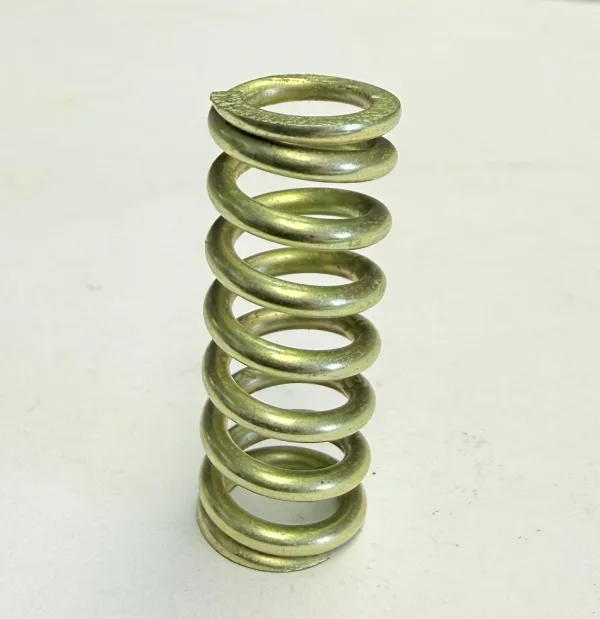

The Graco 122542 die spring is engineered for seamless integration with your high-performance airless sprayer. Designed to provide consistent tension and reliable operation, this component ensures optimal pump performance even under demanding conditions. Featuring superior metallurgy for enhanced durability, precision-machined surfaces, and corrosion-resistant coating, it supports high-pressure filtration systems and minimizes maintenance downtime, making it ideal for professional contractors and industrial coating applications. Installation is quick and straightforward, ensuring minimal downtime between jobs.
This die spring is optimized for use with professional coatings, improving spray accuracy and finish quality. Its compact design fits snugly into Graco pump assemblies, delivering smooth operation and reduced vibration. Upgrade your equipment with this reliable component to maintain peak performance on every job in demanding industrial environments.
$6.3The Graco 122542 Die Spring is a precision-engineered compression component designed to deliver consistent load retention within high-pressure pump assemblies. Manufactured for heavy-duty operation, this die spring sustains the critical seating force integral to hydraulic seals and valve mechanisms in advanced coating delivery systems. Its optimized geometry and controlled dimensional tolerances ensure minimal axial deviation under cyclical loading. Within high-intensity workflows, the spring’s fatigue-resistant profile contributes to uninterrupted throughput when paired with industrial-grade nozzles and manifold blocks. When integrated into an airless sprayer pump module, the 122542 spring supports volumetric consistency and mitigates pressure fluctuations that compromise finish uniformity. Engineered to withstand temperatures up to 204°C and pressures exceeding 3500 psi, the spring’s robust metallurgy guards against creep deformation during extended duty cycles.
As a core replacement component in professional-grade tooling, the Graco 122542 delivers uniform deflection rates that minimize vibrational resonance at high cycle frequencies. By leveraging optimized coil spacing and a precisely controlled spring constant, it aligns with stringent performance guidelines for piston return and low hysteresis thresholds. The spring’s composition primarily comprises oil-tempered chrome silicon steel, subjected to multi-stage heat treatment and shot peening to enhance surface endurance and stress distribution. This rigorous manufacturing protocol maximizes fatigue life, directly influencing pump efficiency and mitigating wear on dynamic seals over extended runtimes. Ideally suited for heavy-viscosity coatings and integrated with advanced block filtration modules, the 122542 spring upholds consistent backpressure characteristics essential to professional coatings systems. Regular inspection of spring end squareness and axial runout can further optimize service intervals and component longevity. Proper installation torque and alignment with mating guide pins ensure minimal eccentric loading, contributing to predictable operational cycles.
For critical applications requiring extended fatigue endurance, the Graco 122542 die spring is produced from a high-tension chrome silicon alloy engineered for exceptional tensile strength and ductility. Following cold coiling, springs undergo a multi-stage thermal conditioning process, including pre-stress stabilization, full-hardening at 900°C, and controlled tempering cycles to achieve a final hardness rating between HRC 45 and 50. The application of a micro-blast surface finish removes residual scale and induces beneficial compressive residual stresses, substantially improving fatigue crack resistance. End configurations are ground flat to within 0.05 mm parallelism specifications, ensuring uniform load distribution across mating surfaces. Dimensional accuracy is monitored via in-line laser gauging, maintaining coil spacing tolerances to ±0.1 mm. This meticulous quality control framework supports long-term seal longevity within high-pressure fluid circuits. Additionally, the corrosion-resistant finish provided by zinc phosphate coating enhances compatibility with aggressive solvent-borne coatings and mitigates the risk of galling within reciprocating assemblies.
Performance evaluation of the Graco 122542 die spring reveals a stable spring rate of 120 N/mm at nominal loads, with linear deflection responses maintained across temperatures ranging from –40°C to 204°C. Endurance testing under 10 million fatigue cycles exhibits less than 2% spring constant degradation, underscoring the component’s reliability in repetitive actuation sequences. When integrated into systems with high-pressure filtration schemes, the spring’s consistent backpressure output helps preserve membrane and filter integrity by dampening pressure spikes. The low relaxation coefficient of under 5% over 1000 hours at rated stress levels contributes directly to sustained pump efficiency and steady fluid metering performance. Dynamic resonance frequencies are optimized to avoid harmonics within typical spray pump operating bands, reducing vibrational wear. Empirical data indicates that proper alignment of the spring axis with valve stem guides minimizes lateral forces, prolonging seal longevity and promoting uninterrupted operation in demanding coating delivery cycles.
Installation of the Graco 122542 spring requires precise axial alignment within the pump cylinder bore, supported by guide sleeves to prevent eccentric loading. Tools such as calibrated spring compressors and dial indicators can verify compression stroke thresholds and end squareness within tolerance bands. Routine maintenance schedules should include periodic inspection for coil deformation, surface pitting, and oxide formation that could impede performance in high-viscosity media. Lubrication with compatible silicone-based greases or PTFE-based fluids preserves friction coefficients and extends service intervals. As part of maintenance, integrating a pressure relieve cycle during shutdown sequences aids in residual stress relaxation and prevents end-set accumulation. Such practices directly influence pump efficiency by minimizing energy losses due to spring hysteresis and enhancing seal longevity by reducing unbalanced loading. Leveraging condition monitoring techniques, including acoustic emission analysis and optical deformation sensing, can preemptively detect fatigue anomalies before critical failure, ensuring continuous operation in demanding professional coating processes.
Subscribe to our newsletter to get exclusive discounts and new theme launches right in your inbox.
You may unsubscribe at any moment. For that purpose, please find our contact info in the legal notice.