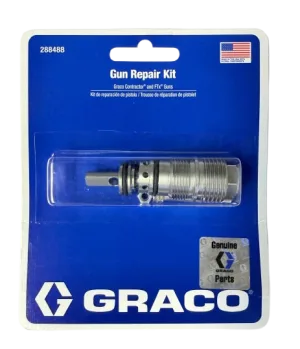
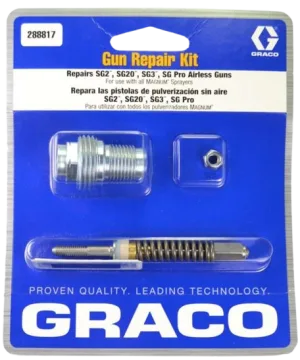
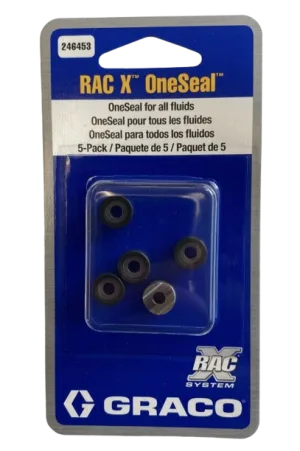
When the gun spits tells you why it spits. A spit at the start of the trigger pull, or a drip after you let go, points to the tip seal or a worn needle and seat. Sputtering all the way through a pass points to air in the paint or pressure too low for the tip. A pattern that spits and tails at the edges points to a worn or partly blocked tip. Clear the tip first, reseat the seal, bleed the air, then look at the needle. The parts involved are gun repair kit 288488 (Contractor and FTx guns), 288817 (SG2 and SG3) and OneSeal pack 246453.
- Spitting is a symptom with six common causes. Guessing at parts is slower than reading the symptom.
- Four of the six cost nothing to check: the tip, the seal, the paint level and the pressure setting.
- A gun that drips with the trigger released needs a needle and seat, not a new tip.
- Gun parts are specific to the gun model, not to the sprayer it is attached to.
- Read the Symptom First
- Cause 1: A Partly Blocked or Worn Tip
- Cause 2: The Tip Seal Is Damaged or Not Seated
- Cause 3: A Worn Needle and Seat
- Cause 4: Air in the Paint Line
- Cause 5: Pressure Too Low for the Tip
- Cause 6: The Paint and the Trigger Hand
- A Five-Minute Test That Isolates the Cause
- Airless Spitting Is Not HVLP Spitting
- Keeping a Gun From Spitting Again
- Frequently Asked Questions
A spitting gun ruins work in a very specific way. The wall looks fine until the light hits it from the side, and then every pass has a constellation of heavy dots at its start. On a cabinet door or a front door it means sanding back and starting again.
Most advice on this lumps every kind of spitting together and ends with "replace the tip." That fixes one cause out of six. The quicker route is to notice exactly when the spit happens, because each cause has its own signature.
1. Read the Symptom First
Spray a test pass on cardboard and watch the first inch, the middle and the moment you release the trigger. Then find your pattern in this table.
| What you see | Most likely cause | Check first |
|---|---|---|
| A burst of heavy drops at the start of each pass | Tip seal, or a partial clog in the tip | Reverse the tip to clear it, then reseat the seal |
| A spit or drip just after you release the trigger | Worn needle and seat | Hold the gun still, trigger released, and watch the tip |
| Sputtering or fluttering through the whole pass | Air in the paint line | Paint level, suction connections, priming |
| Heavy edges (tails) plus the odd spit | Pressure too low, or a worn tip | Turn pressure up, then try a new tip |
| Fine at first, worse as the job goes on | Gun filter or manifold filter loading up | Pull and clean the gun filter |
| Random spits with no pattern | Unstrained or partly dried paint | Strain the paint, flush the gun |
Switch the sprayer off, turn the prime valve to release pressure, trigger the gun into a pail and set the trigger lock. Airless pressure can inject paint through skin. Never wipe a tip with your finger while the system is pressurized.
2. Cause 1: A Partly Blocked or Worn Tip
The tip is the smallest opening in the whole system, so it is where trouble shows first.
A partial clog
A flake of dried paint that does not block the orifice completely will deflect the stream instead. The gun spits, the fan comes out lopsided, or a "finger" of paint shoots off to one side. Reversible tips exist for exactly this. Turn the tip 180 degrees to the unclog position, aim into a waste pail, pull the trigger for a second, and turn it back.
If the same tip clogs again within minutes, the tip is not the problem. Something upstream is letting debris through, and the answer is in the filters.
A worn tip
Paint is abrasive, and every gallon enlarges the orifice slightly. A worn tip gives a narrower fan with heavy edges, and it passes more paint than the number on it suggests. The pump has to work harder to feed it, the pressure at the gun falls, and the pattern starts to spit at the beginning of each stroke.
A simple test: spray a pass at your normal pressure. If the fan is noticeably narrower than it used to be, or if tails remain however far you turn the pressure up, the tip is finished. Our Graco spray tip size chart shows what fan width each tip number should give.
3. Cause 2: The Tip Seal Is Damaged or Not Seated
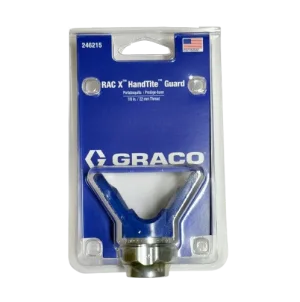
Behind every SwitchTip sits a small seal and seat, held in place by the tip guard. On Graco RAC X and RAC 5 tips this is the one-piece OneSeal. Its job is to seal the tip to the gun so the only way out for paint is through the orifice.
When that seal is cut, worn, missing or installed the wrong way round, paint escapes around the tip. You see it as a spit at the start of the pass, a drip that forms on the guard, or paint running down the front of the gun.
It is the most overlooked part on the gun, for a simple reason: it often falls out during cleaning and nobody notices. Check three things:
- The seal is actually there. Look into the guard before you fit the tip.
- It faces the right way. The curved saddle matches the round barrel of the tip.
- The guard is tightened firmly by hand onto the gun.
OneSeals are sold in packs (246453 is the five-pack for RAC X) and cost very little. Fitting a new one with every new tip is cheap insurance. If you are unsure of the assembly order, see our step-by-step guide to airless spray tip installation.
4. Cause 3: A Worn Needle and Seat
This is the classic cause of spitting on release, and no amount of tip changing will cure it.
Inside the gun, a needle with a hardened ball on its end is held against a seat by a spring. Pulling the trigger lifts the needle and lets paint through. Releasing the trigger should snap it shut instantly. After enough gallons, the ball and the seat wear, and the valve no longer closes cleanly. For a fraction of a second paint keeps coming at falling pressure, and it leaves the tip as coarse drops instead of a fine spray.
The test takes ten seconds. Pressurize the sprayer, hold the gun still with the trigger released, and watch the tip for half a minute:
- Dry tip: the needle is sealing. Look elsewhere.
- A drop that slowly forms and falls: the needle and seat are worn.
- A steady weep: they are well past due, or debris is holding the needle open. Flush the gun and test again before ordering.
Replace the needle and seat together. A new needle against a worn seat will leak again quickly. The kit depends on the gun:
| Gun | Repair part | Notes |
|---|---|---|
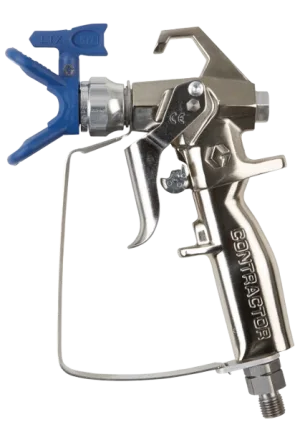
| Contractor and FTx guns | 288488 gun repair kit | The common contractor gun family across many Graco sprayers |
| SG2 and SG3 guns | 288817 gun repair kit | The guns supplied with Magnum sprayers |
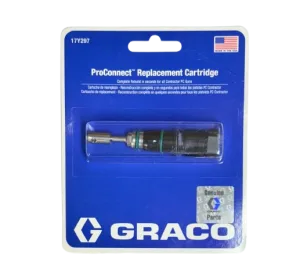
| Contractor PC gun | 17Y297 ProConnect cartridge | The needle assembly is replaced as one cartridge |
Guns get swapped between machines all the time. Read the marking on the gun body or handle and order for that gun. The listings for SG2 and SG3 spray guns and the Contractor and Contractor Compact gun show each gun's parts on a diagram.
5. Cause 4: Air in the Paint Line
An airless sprayer is supposed to pump liquid only. Any air that gets into the fluid compresses and expands as it travels, and it leaves the tip as a sputter. If the spray flutters all through the pass instead of just at its ends, this is the first place to look.
Air gets in at four points:
- A low pail. When the suction tube is close to the surface, the pump draws a mix of paint and air. Top up or tilt the pail so the inlet stays covered.
- A loose or cracked suction tube. Tighten the connection at the pump inlet and inspect the tube for splits.
- Incomplete priming. If you switched to spray before the prime tube ran clear of bubbles, air is still in the pump. Prime again until the flow is solid.
- Foamy paint. Paint that has just been shaken on a machine, or stirred too hard with a drill mixer, is full of fine bubbles. Let it stand for a few minutes.
After fixing the source, bleed the line: with the tip guard off the gun or the tip reversed, trigger into the pail until the stream is smooth and unbroken. Sputtering that comes with a regular surge in the fan is a slightly different fault, covered in our guide to a sprayer pulsing while painting.
6. Cause 5: Pressure Too Low for the Tip
Airless atomization depends on pressure. Below the level a given tip and coating need, the paint leaves as a coarse, uneven sheet: heavy lines at the top and bottom of the fan and spits at the start of each pass.
Low pressure at the gun has three sources, and only one of them is the pressure knob.
- The setting. Raise the pressure gradually until the tails just disappear, then stop. More than that only wears the tip and pump faster.
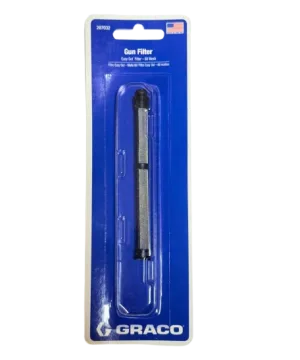
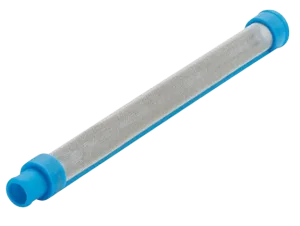
- A restriction. A gun filter packed with dried paint chokes the flow. Pull it from the handle and hold it to the light. Clean it or replace it: 287032 is the 60 mesh filter and 287033 the 100 mesh.
- Demand the pump cannot meet. A tip larger than the sprayer is rated for, a worn tip, or too much small-diameter hose all pull pressure down. No setting fixes that.
If the pressure will not come up at all, work through our guide to fixing a Graco sprayer that will not build pressure before buying anything for the gun.
7. Cause 6: The Paint and the Trigger Hand
Two causes have nothing to do with parts.
Paint that is too thick, cold or unstrained
Skins, lumps and bits of dried paint from the rim of the can travel as far as the first filter that stops them. If the filters are too coarse or missing, they reach the tip and deflect the stream. Strain paint from any can that has been opened before. Cold paint is thicker than the same paint at room temperature and needs more pressure to atomize, so bring it indoors the night before.
Triggering while the gun is still
Even a perfect gun delivers slightly more paint in the instant the needle opens. If the gun is pointing at the work and not moving at that moment, it shows as a heavy spot. Start the stroke first, pull the trigger as the gun passes the edge of the work, and release before you stop. It is the cheapest fix in this article, and it hides the small start-up burst that every airless gun has.
8. A Five-Minute Test That Isolates the Cause
If the symptom is not clear cut, this sequence separates the causes with water and no parts.
- Flush to clean water
Relieve pressure, move the suction tube to a pail of water and flush until the gun runs clear. Paint problems are now ruled out.
- Spray water with the tip reversed
You should get a single solid stream. A broken, sputtering stream means air in the system or a pump valve problem, not the gun.
- Turn the tip to spray and test the pattern
Spits at the start that were not there with the tip reversed point to the tip or its seal.
- Release the trigger and watch the tip
A drip in the next thirty seconds is the needle and seat.
- Swap in a known good tip and seal
If the problem goes away, you have your answer for the price of a tip.
9. Airless Spitting Is Not HVLP Spitting
A lot of search results for "spray gun spitting" are about HVLP guns, and the advice does not transfer. An HVLP gun atomizes with a stream of air, so its spitting usually comes from a loose fluid nozzle, a blocked vent or air cap, or a packing nut that needs adjusting. An airless gun has no atomizing air at all. Tightening things that an airless gun does not have wastes an afternoon.
If your gun has a cup and an air cap, you want our guide to common HVLP spray gun issues instead.
10. Keeping a Gun From Spitting Again
- Clean the gun every time you flush. Take out the filter, rinse the tip and guard, and check the seal is still in the guard.
- Match the gun filter to the tip. Fine mesh for small tips and thin coatings, coarser mesh for large tips and heavy coatings.
- Keep a spare tip and seal on the job. They are the two parts most likely to fail mid-wall.
- Do not hang the gun in a pail of thinner overnight unless the gun manual allows it. Long soaking is hard on seals.
- Replace the needle and seat at the first slow drip. It only gets worse, and a dripping gun wastes paint on every trigger pull.
For a routine that covers the whole gun, see how to clean and maintain your spray gun.
Not Sure Which Gun You Have?
Send us a photo of the gun and any marking on the body. We will identify it and confirm the right repair kit before you order.
Ask Our Parts Team Call +1 713-931-4102Gun Parts That Stop Spitting and Dripping
11. Frequently Asked Questions
Why is my airless paint sprayer gun spitting?
The six usual causes are a partly blocked or worn tip, a damaged or badly seated tip seal, a worn needle and seat inside the gun, air in the paint line, pressure that is too low for the tip, and paint that is too thick or unstrained. When the spit happens points to the cause: a spit at the start or a drip after you let go of the trigger points to the needle and seat or the tip seal, while sputtering all through the pass points to air in the fluid or low pressure.
Why does my spray gun spit when I release the trigger?
Because the needle is not closing cleanly against its seat. Paint under pressure keeps escaping for a moment after you let go, and it leaves the tip as a spit or a drip. Wear on the needle and seat is the usual reason. A damaged tip seal, or a tip seal that is not seated properly, causes the same symptom. Replace the needle and seat together with the correct gun repair kit.
How do I fix a paint gun that is sputtering?
Start with air and supply. Check that the suction tube is fully under the paint, tighten the suction connections, and prime the sprayer again until the flow from the prime tube is steady with no bubbles. Then clean or replace the gun filter and turn the pressure up until the spray pattern has no heavy edges. If it still sputters with a new tip, inspect the pump inlet and outlet valves.
Can a worn spray tip cause spitting?
Yes. As a tip wears, the orifice grows and loses its shape. The fan gets narrower, the edges get heavy, and the pattern can spit at the start of each pass. A worn tip also passes more paint than the sprayer can supply, so the pressure drops. If turning the pressure up no longer clears the tails, replace the tip.
Which gun repair kit do I need for a Graco airless gun?
It depends on the gun, not the sprayer. In our listings, kit 288488 is the gun repair kit for the Contractor and FTx gun family, kit 288817 covers the SG2 and SG3 guns supplied with Magnum sprayers, and the Contractor PC gun uses the ProConnect cartridge 17Y297, which replaces the needle assembly as one piece. Read the model marking on the gun body before ordering.
What is a OneSeal and does it matter?
It is the one-piece seal and seat that sits behind a RAC X or RAC 5 SwitchTip, inside the tip guard. It seals the tip to the gun. If it is missing, cut, or put in the wrong way round, paint leaks around the tip and the gun spits or drips. OneSeals are inexpensive and worth replacing whenever you fit a new tip.
Is spitting on an airless gun the same problem as on an HVLP gun?
No. An airless gun atomizes paint with fluid pressure alone, so spitting comes from the tip, the seals, the needle or air in the paint. An HVLP gun uses air to atomize, and spitting there usually comes from a loose fluid nozzle, a blocked air cap or a cup problem. The fixes do not carry over from one type to the other.