Every paint sprayer, whatever the brand, has four jobs to do: hold the material, move it, carry it, and break it into droplets. An airless sprayer does the last job with pressure through a tiny orifice, so its parts are pumps, valves, packings and tips. An HVLP sprayer does it with a large volume of moving air, so its parts are turbines, air caps, fluid nozzles and needles. Knowing which of the four jobs a component belongs to tells you what it is called, what it does, and roughly when it will need replacing.
- The Four Sprayer Types and Why Their Parts Differ
- Airless Sprayer Parts, Component by Component
- HVLP and Air Sprayer Parts
- Handheld and Cordless Sprayer Parts
- Texture and Drywall Sprayer Parts
- The Name Problem: Same Part, Different Word
- Do Parts Cross Between Brands?
- Where to Go From Here
- Frequently Asked Questions
Most people arrive at this topic the same way. Something on the sprayer stopped working, and now there is a component in hand or a symptom on screen and no confident word for it. Search results come back full of part numbers that assume you already know what you are looking at.
This page starts one step earlier than that. It explains what each part of a paint sprayer actually does, what it is commonly called, and how to tell when it has worn out. It covers airless, HVLP, handheld and texture equipment, and it is written for whatever brand you happen to own.
1. The Four Sprayer Types and Why Their Parts Differ
Before naming components, it helps to know which family your machine belongs to, because the atomizing method determines nearly every part downstream of the motor.
| Type | How it atomizes | Signature parts | Usually found on |
|---|---|---|---|
| Airless | High pressure forces paint through a small orifice | Piston pump, valves, packings, spray tip | Walls, exteriors, fences, production work |
| HVLP | High volume of low pressure air shears the paint stream | Turbine, air cap, fluid nozzle, needle | Cabinets, furniture, fine finish work |
| Air assisted airless | Pressure plus a small amount of shaping air | Both pump parts and air cap parts | Industrial finishing, millwork |
| Texture and mortar | Pumps heavy aggregate loaded material | Heavy duty pump, large bore hose, texture nozzle | Drywall, ceilings, stucco |
Airless is the largest category by far in residential and commercial painting, so most of this guide covers it. The other three get their own sections below.
2. Airless Sprayer Parts, Component by Component
Follow the paint from bucket to wall, and the parts introduce themselves in order.
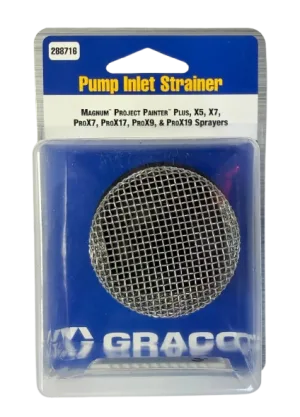
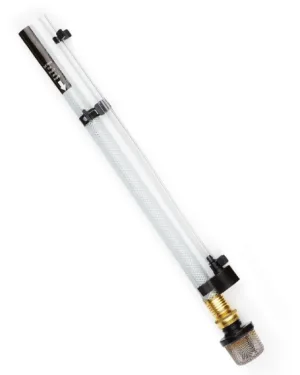
Suction tube and inlet strainer
Also called: siphon tube, intake tube, pickup tube, inlet filter, rock catcherThe tube that reaches into your paint bucket, with a coarse mesh screen on the end. The screen exists to stop dried skin, grit and debris from ever entering the pump.
How it fails: The screen clogs, or the tube develops a crack that lets it suck air instead of paint. Both show up as a machine that will not prime. Cost: among the cheapest parts on the machine, and worth checking first on any priming complaint.
Inlet valve
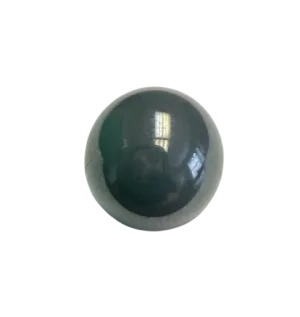
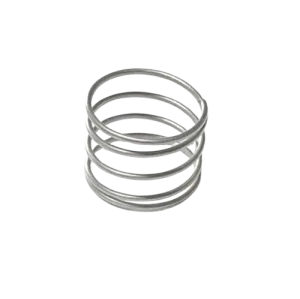
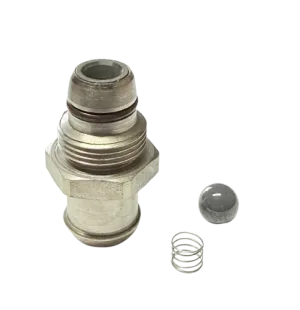
Also called: foot valve, intake valve, lower check valve, inlet ball and seatA one way check valve at the bottom of the pump. On the piston's upstroke it opens and lets paint in. On the downstroke it closes so paint cannot escape back down the tube. It is usually a hardened ball seating against a machined seat, with a spring.
How it fails: The ball or seat wears, or dried material holds the ball open. The machine loses prime, or will not hold pressure when idle.
Piston and cylinder
Also called: displacement rod, pump rod, fluid section, lower, the pumpThe moving heart of an airless sprayer. A hardened rod reciprocating inside a machined cylinder, pressurizing paint on every stroke. Quality here is what separates a homeowner machine from a contractor one: chrome plated or stainless components on the better units, lighter materials on the entry level ones.
How it fails: Scoring on the rod, or wear in the cylinder bore. Usually replaced as a complete assembly rather than piece by piece, because the two must match dimensionally.
Packings
Also called: seals, seal kit, pack-off, throat packings, V-packings, repacking kitStacked seals, usually leather and polyethylene alternating, that wrap around the piston and stop pressurized paint from escaping past it. They are consumable by design. Every airless sprayer will need repacking eventually.
How it fails: Friction and solvent exposure degrade them, or they dry out during storage. The tell is paint or solvent weeping around the pump housing. Do not keep spraying through it, because a leaking pump wears the cylinder faster.
Outlet valve
Also called: upper check valve, piston valve, outlet ball and seatThe second one way valve, sitting above the piston. It lets pressurized paint move up and out toward the hose, and stops it flowing back into the cylinder.
How it fails: Same wear pattern as the inlet valve. The classic symptom is pressure that holds at startup then falls off under sustained spraying.
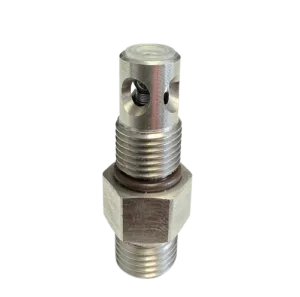
Prime and drain valve
Also called: bypass valve, pressure relief valve, PRIME/SPRAY valve, drain valveThe lever you flip between prime and spray. In prime position it routes material back into the bucket through the drain tube, letting the pump push air out of the system. In spray position it sends material to the hose. It also serves as a pressure relief, which makes it a safety component, not just a convenience.
How it fails: Internal seals wear or dried material fouls the passage. The machine will not switch cleanly between prime and spray, or will not relieve pressure.
Manifold filter
Also called: pump filter, outlet filter, high pressure filter, fluid filterA cylindrical mesh screen between the pump and the hose. It catches anything that made it past the inlet strainer before it can reach the tip.
How it fails: It clogs. A clogged manifold filter convincingly imitates pump failure, which is why it belongs near the top of any diagnostic list rather than the bottom.
High pressure hose and whip hose
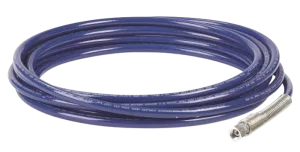
Also called: airless hose, fluid hose, whip end, leader hoseBraided hose rated well above your machine's working pressure. A whip hose is a short, more flexible section joining main hose to gun, which noticeably reduces hand fatigue over a long day.
How it fails: Soft spots, kinks, or weeping at the fittings. This is a safety item. Airless material at working pressure can inject through skin. A damaged hose gets replaced, not taped.
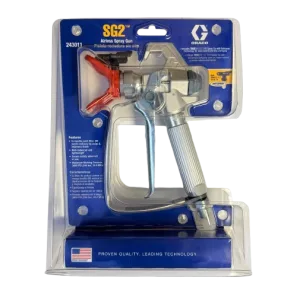
Spray gun, needle and seat
Also called: trigger assembly, gun repair kit, needle and seat kit, diffuserThe gun is a valve you hold. Pulling the trigger retracts a needle off its seat and lets pressurized material through to the tip. A diffuser behind the tip helps break up the stream and reduces pressure spikes.
How it fails: Needle and seat wear, so the gun drips after you release the trigger. A gun repair kit is far cheaper than a new gun and is a straightforward bench job.
Gun filter
Also called: handle filter, inline filter, gun screenA small mesh filter inside the gun handle, the last line of defence before the tip. Mesh size should be matched to tip size: finer mesh for small orifices, coarser mesh for large ones.
How it fails: Clogs, causing spitting or a starved pattern that looks exactly like a pressure problem.
Spray tip and tip guard
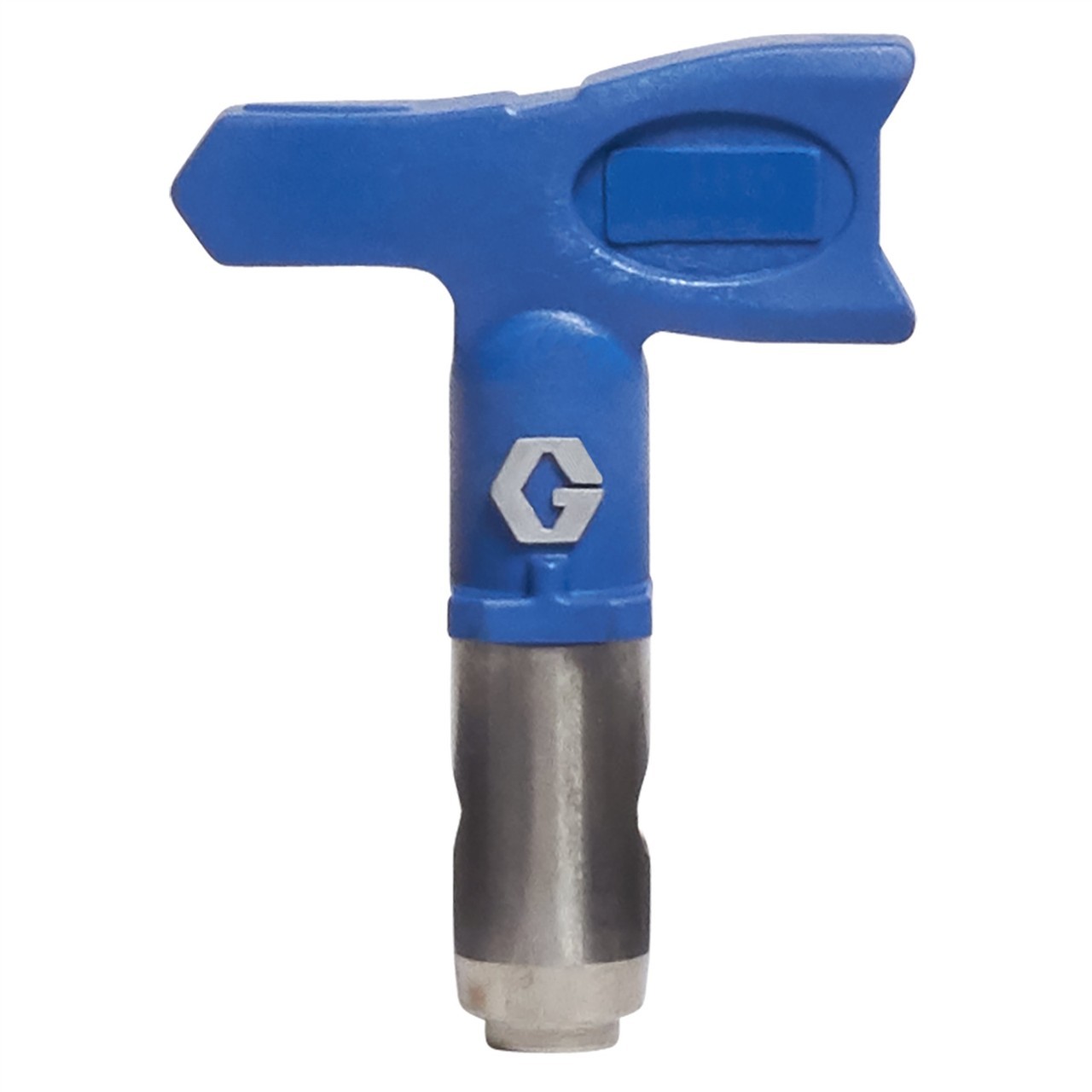
Also called: nozzle, SwitchTip, reversible tip, tip and guard assemblyA precisely sized orifice, usually tungsten carbide, that turns a pressurized stream into a fan. Reversible designs let you rotate the tip to blast out a clog without disassembly. The guard holds the tip and keeps your hand away from the spray, which is a genuine safety function.
How it fails: The orifice widens from abrasion. A worn tip sprays a narrower, heavier, less even pattern. It is the most frequently replaced part on any airless sprayer.
Motor, drive and controls
Also called: drive assembly, connecting rod, gearbox, pressure control board, transducerThe motor turns, the drive converts that rotation into the piston's up and down stroke, and the control system reads pressure and adjusts motor speed to hold it steady. The pressure sensing component is usually called a transducer.
How it fails: Rarely, and usually late in the machine's life. A motor that runs with no piston movement points at the drive. Erratic pressure that ignores the control knob points at the transducer or board.
Know the Part, Need the Number?
Match your component against a factory diagram and read off the exact part number
Find My Part by Diagram Call +1 713-931-41023. HVLP and Air Sprayer Parts
HVLP stands for high volume, low pressure. Rather than forcing paint through a tiny hole, it uses a large moving volume of air to shear a low pressure paint stream into droplets. Softer atomization, far less overspray, much slower coverage. It is the right tool for cabinets, furniture and trim, and the wrong tool for a house exterior.
Turbine or compressor
Also called: power unit, blower, air sourceThe air supply. Turbine systems use a dedicated multi stage blower. Conversion guns run off a shop compressor instead. Turbine stages roughly correspond to available pressure and therefore to how thick a material the unit can handle.
How it fails: Air filters clog, which starves the gun and produces poor atomization that is easy to misread as a gun problem.
Air cap
Also called: air nozzle, aircap set, horn capThe front piece with multiple holes. The centre hole surrounds the fluid stream with air, and the side holes, called horns, flatten the round pattern into a fan. Rotating the cap changes fan orientation between horizontal and vertical.
How it fails: Individual holes clog with dried material, producing a lopsided pattern. Usually cleanable rather than replaceable, but never with a metal pick, which damages the precision openings permanently.
Fluid nozzle and needle
Also called: fluid tip, fluid set, needle and nozzle setThe HVLP equivalent of an airless tip and seat, and they are a matched pair. The needle seats inside the nozzle to shut off flow, and the nozzle orifice size determines how much material passes. Nozzle sizing is quoted in millimetres, commonly 1.0 to 2.0 mm depending on material thickness.
How it fails: Wear or a damaged needle tip causes dripping and inconsistent flow. Replace as a set, never individually, because they wear into each other.
Cup, lid and gasket
Also called: pot, canister, gravity cup, siphon cupThe material container. Gravity feed cups mount on top of the gun, siphon cups underneath. Both rely on a vent so air can replace the material being drawn out.
How it fails: The lid gasket hardens and leaks, or the vent clogs and the gun stops feeding, which mimics a nozzle problem.
4. Handheld and Cordless Sprayer Parts
Battery powered handhelds compress the whole airless architecture into something you carry. The parts list is shorter, and the wear items are different in an important way.
- Flexible liner bags. Many handhelds spray from a disposable liner rather than a rigid cup, which means you can spray at any angle and cleanup is much faster. The liners themselves are consumables.
- Battery and charger. The most common long term failure on a cordless unit, and often the point at which people wrongly assume the sprayer itself has died.
- Piston pump assembly. Same principle as a full size airless pump, much smaller, and generally replaced as a unit rather than rebuilt.
- Tip and seal assembly. Handheld tips are a different system from full size RAC X tips and do not interchange.
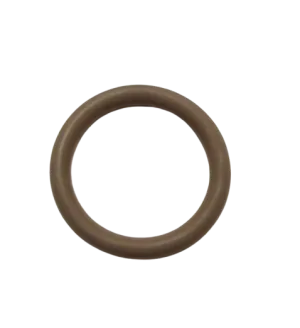
- O-rings and seals. Handhelds cycle their seals more often relative to their size, so small O-ring failures are proportionally more common. This is the part people most often replace on a handheld.
If you are servicing a cordless unit, our GX21 cordless airless sprayer parts and homeowner sprayer parts sections cover the handheld and entry level range.
5. Texture and Drywall Sprayer Parts
Texture equipment moves material loaded with aggregate, which behaves nothing like paint inside a pump. The component names carry over from airless, but the service assumptions do not.
- Everything wears faster. Aggregate is abrasive in a way that smooth latex is not. Pump components and tips on a texture rig reach end of life well before the same parts would on a paint sprayer used equally.
- Larger bore everything. Hoses, passages and nozzles are sized for material that will not pass through paint sized openings.
- Texture nozzles instead of spray tips. Sized and shaped to produce a pattern rather than an even film, and usually selected by desired texture rather than by fan width.
- Cleaning is not optional. Texture compound sets rather than simply drying. Material left in the system after a job is the leading cause of texture equipment failure, ahead of ordinary wear.
See drywall finishing and texture sprayer parts for this equipment class.
6. The Name Problem: Same Part, Different Word
A large share of wrong part orders trace back to vocabulary rather than mechanics. The same component carries different names depending on the manufacturer, the manual, and the person you are talking to. This table is the translation layer.
| If you call it | It may also be called | What it actually is |
|---|---|---|
| Nozzle | Tip, SwitchTip, reversible tip, spray tip | The orifice that forms the fan pattern |
| Seals | Packings, pack-off, seal kit, V-packings | Stacked seals around the piston |
| The pump | Fluid section, lower, displacement pump | Piston, cylinder and packings as an assembly |
| Foot valve | Inlet valve, intake valve, lower check valve | One way valve below the piston |
| Bypass valve | Prime valve, drain valve, PRIME/SPRAY valve | Routes material back to the bucket, relieves pressure |
| Pressure sensor | Transducer, pressure control sensor | Tells the control board what the pressure is |
| Siphon tube | Suction tube, intake tube, pickup tube | Draws material out of the bucket |
| Rock catcher | Inlet strainer, inlet filter, intake screen | Coarse screen at the suction tube end |
| Whip | Whip hose, leader hose, whip end | Short flexible hose between main hose and gun |
| Trigger kit | Gun repair kit, needle and seat kit | The wear parts inside the spray gun |
When you contact any parts supplier, lead with three things: the model number off the machine label, what the machine is doing wrong, and where on the machine you are looking. That combination gets you to the right part faster than any name will, because it lets the person on the other end work from the diagram instead of from vocabulary.
7. Do Parts Cross Between Brands?
We sell genuine Graco parts, so treat what follows as information rather than a sales pitch. The honest answer differs by component.
Sometimes crosses between brands
- High pressure hoses, when thread size and pressure rating match. Airless hose fittings are relatively standardized, and a hose rated above your machine's maximum is generally fine.
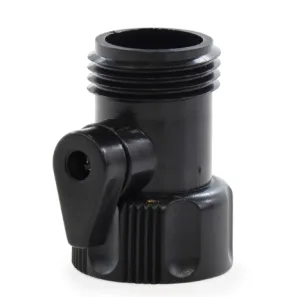
- Some fittings and adapters, particularly common thread sizes. Adapters exist specifically because thread standards vary between gun and hose combinations.
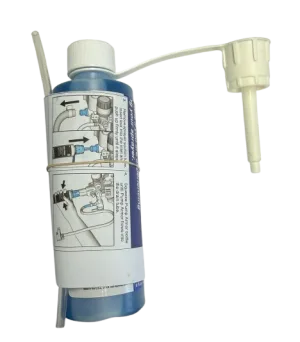
- Generic consumables such as pump storage fluid, which are not brand specific.
Almost never crosses between brands
- Spray tips and guards. Each manufacturer designs its own tip seating and guard geometry. A tip that threads in is not necessarily seating correctly, and a poor seal at the tip leaks at full working pressure.
- Pump internals, valves and packings. Dimensionally specific to each manufacturer's pump design, with no meaningful crossover.
- Guns and gun repair kits. Needle, seat and diffuser geometry is proprietary.
- Electronic components. Control boards, transducers and switches are brand and model specific.
We stock Graco OEM, so for a Wagner, Titan or store brand machine we are usually not your best source, and we would rather say so than sell you something that does not fit. Two things do still apply universally: hoses cross when the rating and threads match, and the diagnostic logic in this guide works on any airless sprayer regardless of badge. If you are weighing a move to Graco equipment, browse the machine range or ask us what would suit your work.
8. Where to Go From Here
Now that the components have names, the next step depends on what you came here to do.
- You know which part failed and need the number. Go to the parts diagram lookup and match it visually.
- You own a Graco and want the compatibility detail. Our cross-model airless parts reference covers what interchanges between Graco models and what does not.
- You need a tip and are unsure of sizing. Start at spray tips and guards.
- You are chasing a pressure or priming fault. Check filters and strainers before assuming pump failure, then pump repair kits.
- The gun is dripping. See spray guns and repair kits.
- You want the original documentation. The manuals and technical data library is organized by model.
Common Replacement Parts
 −37%
−37%
9. Frequently Asked Questions
What are the main parts of a paint sprayer?
Every paint sprayer has a material source, a way to move material under pressure or airflow, a delivery line, and an atomizing device. On an airless sprayer that means a suction tube, a piston pump, a high pressure hose, and a spray tip. On an HVLP sprayer it means a cup, a turbine or compressor, an air hose, and an air cap with a fluid nozzle and needle.
What is a spray tip and why does it wear out?
A spray tip is a precisely sized orifice, usually tungsten carbide, that breaks paint into a fan pattern. It wears because paint contains solids that are abrasive when forced through a small opening at high pressure. As the orifice widens, the fan narrows and thickens, so a worn tip sprays more material over less area.
What are packings on a paint sprayer?
Packings are stacked seals that surround the piston inside an airless pump and keep pressurized material from escaping past it. They wear from friction and from solvent exposure during cleaning. The usual sign that packings have failed is paint or solvent weeping around the pump housing.
Do paint sprayer parts work across different brands?
Rarely, and it depends on the part. Hoses and some fittings cross brands when thread size and pressure rating match. Spray tips generally do not, because tip seating and guard designs are proprietary to each manufacturer's system. Pump internals, valves and electronic controls never cross brands.
What is the difference between airless and HVLP sprayer parts?
Airless sprayers use a pump to pressurize paint and atomize it through a tip, so their wear parts are tips, valves and packings. HVLP sprayers use a high volume of low pressure air to atomize paint, so their wear parts are air caps, fluid nozzles, needles and air filters. The two systems share almost no components.
Still Not Sure What You Are Looking At?
Send us your model number and a photo. We will identify the part before you order.
Ask Our Parts Team Browse All Parts